The Franchise Lease Trap: Why Franchisees Face Lease Risks That Independent Tenants Don’t
A fitness franchisee opened her second location. The franchisor approved the site. The buildout met brand standards. The business performed well.
Then she tried to sell her franchise. The buyer was ready. The price was agreed. And the landlord’s consent clause blocked the transfer.
The lease required landlord approval for any assignment. The landlord agreed to consent — for a price. They demanded a lease amendment with higher rent and a new personal guarantee from the buyer. The deal nearly fell apart. The franchisee lost months of negotiating time and accepted terms she hadn’t planned for.
Franchise leases are not standard commercial leases. They carry a distinct set of risks that most franchisees discover too late: the lease term and franchise term misalign, the use clause doesn’t accommodate the full franchise system, the assignment clause blocks the sale of the business, and the personal guarantee survives long after the franchise relationship ends.
This post explains the traps that make franchise leases uniquely risky — and what to address before you sign.
If you want to know how your franchise lease is structured and where the exposure is, run it through sasir.ai — our AI-powered lease analysis tool. The first scan is free.
The Core Problem: You’re Signing Two Agreements That Don’t Talk to Each Other
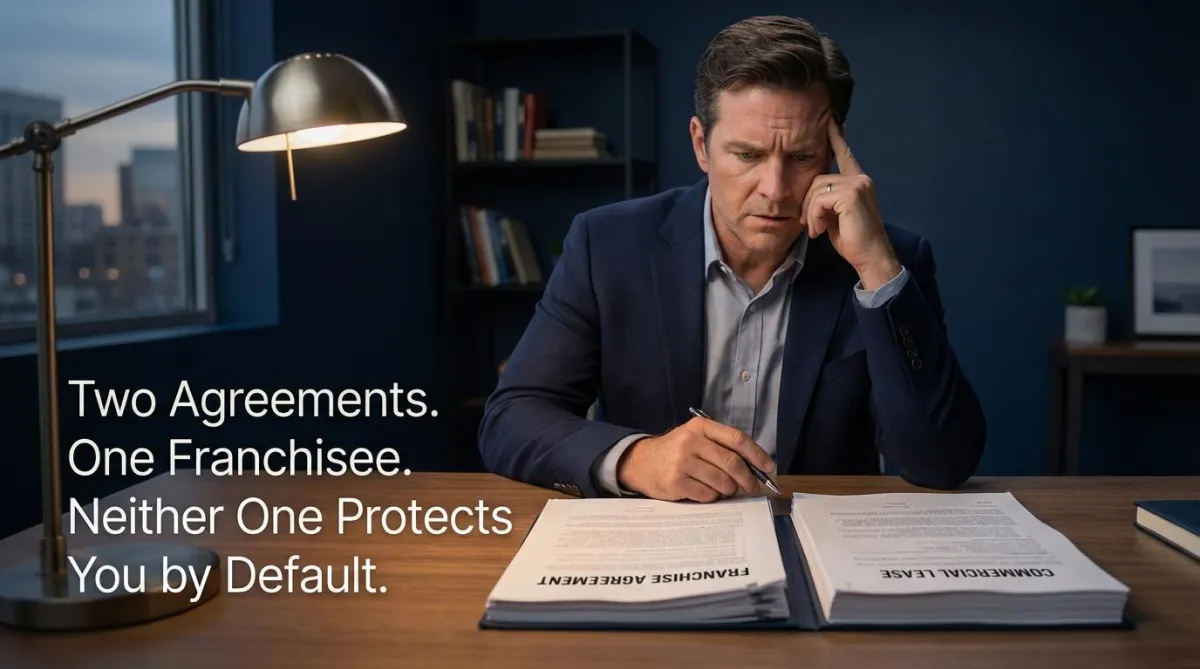
Every franchisee operates under two binding contracts simultaneously: the franchise agreement with the franchisor, and the lease with the landlord. These two documents were created independently, by different parties, with different interests. They do not automatically align.
When they conflict — and they frequently do — the franchisee is caught between two obligations with no clean resolution. The lease says one thing. The franchise agreement requires another. The franchisee is the only party who is bound by both.
The most dangerous franchise lease traps are the points where this misalignment creates specific, quantifiable financial exposure.
Trap 1: Lease Term vs. Franchise Term Mismatch
A franchise agreement typically runs five to ten years with renewal options. A commercial lease often runs five to ten years as well. On the surface, these seem aligned. In practice, they almost never are.
The problem: the terms begin and end on different dates, have different renewal structures, and are negotiated with different parties. A franchisee who signs a ten-year lease and a ten-year franchise agreement may find that the franchise agreement expires two years before the lease — leaving them bound to pay rent on a space they can no longer legally operate as a franchise.
The nightmare scenario: the franchisor declines to renew the franchise agreement (or the franchisee fails to comply with renewal conditions), but the lease still has two years left. The franchisee is paying rent on a branded space they can no longer use as a franchise. They may not be able to pivot to an independent business quickly enough, and the lease gives them no exit.
The lease should always include a termination right triggered by non-renewal or termination of the franchise agreement. Without it, you can be paying rent on a franchise that no longer exists.
What to negotiate: include a co-terminus provision that aligns the lease term with the franchise agreement, or negotiate an early termination right if the franchise agreement is not renewed. The language: ‘Tenant shall have the right to terminate this Lease upon 90 days’ written notice if the Franchise Agreement between Tenant and [Franchisor] expires or is terminated for any reason.’
Trap 2: The Use Clause Doesn’t Cover the Full Franchise System
The permitted use clause defines what you’re allowed to do in the space. Franchisors regularly update their systems, add products, introduce new service offerings, and evolve their brand standards. If your use clause was written for the franchise system as it existed at signing, system updates can create lease conflicts.
A fitness studio franchisee whose lease says ‘group fitness instruction only’ may find that the franchisor’s updated system requires offering personal training, nutrition counseling, or recovery services. Any of these additions may require landlord consent or a lease amendment — giving the landlord leverage at exactly the moment the franchisee needs to comply with their franchisor.
What to negotiate: broaden the use clause to accommodate the full current and anticipated scope of the franchise system. Include specific language: ‘and any other uses permitted or required under the Franchise Agreement between Tenant and [Franchisor], as amended from time to time.’ This catches system updates without requiring a lease amendment every time the franchisor evolves.
Trap 3: The Assignment Clause Blocks the Sale of Your Business
When a franchisee sells their franchise, the buyer typically needs to take over the lease on the existing space. This is a lease assignment. And most commercial leases require landlord consent for any assignment.
In many landlord-drafted leases, that consent is at the landlord’s ‘sole discretion’ or subject to conditions the landlord sets. This gives the landlord enormous leverage at exactly the point when the franchisee needs to close a sale: they can demand higher rent, a new personal guarantee from the buyer, a lease amendment, or a transfer fee. All of these can kill or substantially degrade the deal.
The compounding problem: the franchisor typically also needs to approve the buyer and the transfer. So the franchisee needs consent from two parties simultaneously — the landlord and the franchisor — with no guarantee either will respond on a reasonable timeline.
What to negotiate: consent to assignment should be ‘not unreasonably withheld, conditioned, or delayed.’ Define reasonable criteria explicitly. Negotiate a deemed-approval mechanism if the landlord fails to respond within a defined window (typically 30 days). And negotiate release of the original franchisee’s personal guarantee upon a qualified assignment — so the seller is not continuing to guarantee a lease for a business they no longer own.
A franchise you cannot sell without landlord consent on onerous terms is a franchise that may be worth significantly less than you planned. The assignment clause is the most direct driver of franchisee exit value.
Trap 4: The Personal Guarantee Doesn’t Have an Exit
Most franchise leases require a personal guarantee from the franchisee. In a franchise context, this is standard and expected. The problem is not the guarantee itself — it’s the absence of any provision for releasing or limiting it over time.
An unlimited personal guarantee with no burn-off, no cap, and no release upon assignment means the franchisee remains personally liable for the lease for as long as they own the franchise — and potentially beyond, if the guarantee contains survival language. For multi-unit franchisees, a guarantee on each location compounds this exposure significantly.
What to negotiate: a performance-based guarantee burn-off (guarantee reduces after 24–36 months of timely payment), a cap on guarantee exposure (limited to twelve months of base rent), and an explicit release provision upon a qualified assignment to an approved buyer.
Trap 5: Reduced Negotiating Leverage Because the Franchisor Approved the Site
This is the structural trap that enables all the others. When a franchisee enters lease negotiations, the franchisor has already approved the site. That approval creates a dynamic where the franchisee feels — and often is — committed to the location before the lease is signed. They’ve invested time and resources in site approval. The franchisor may have specific requirements that limit the franchisee’s ability to walk away if the lease terms are unfavorable.
The landlord knows this. A landlord negotiating with a franchisee who has already secured site approval from their franchisor is negotiating with someone who has less flexibility to walk. The result: weaker negotiating position on exactly the lease terms that matter most for long-term profitability.
The countermeasure: begin lease negotiation before finalizing site approval, so the franchisee retains the option to decline a site with unacceptable lease terms. And negotiate the franchise agreement itself to include LOI review rights and lease term requirements, so the franchisor’s site approval is conditioned on acceptable lease terms — not the reverse.
The Franchise Lease Checklist
Co-terminus or termination right if franchise agreement expires or terminates
Use clause broad enough to cover the full franchise system including future updates
Assignment consent standard: not unreasonably withheld, conditioned, or delayed
Deemed-approval mechanism if landlord fails to respond within 30 days
Release of personal guarantee upon qualified assignment to approved buyer
Personal guarantee cap and burn-off schedule
Begin lease negotiation before franchisor site approval is finalized
Verify lease term aligns with franchise agreement renewal cycle
The Bottom Line
Franchisees operate under two contracts and face the risks of both. The lease was written by a landlord with no knowledge of your franchise agreement. The franchise agreement was written by a franchisor with no responsibility for your lease terms. Bridging the gap between them is your job — and it has to happen before you sign.
These resources from our core commercial lease series are directly relevant to franchise tenants:
If you want to know how your franchise lease is structured and where the exposure is, run it through sasir.ai. The first scan is free.