CAM Charges in Franchise Leases: Why Operating Expenses Hit Franchisees Harder — and What to Do About It
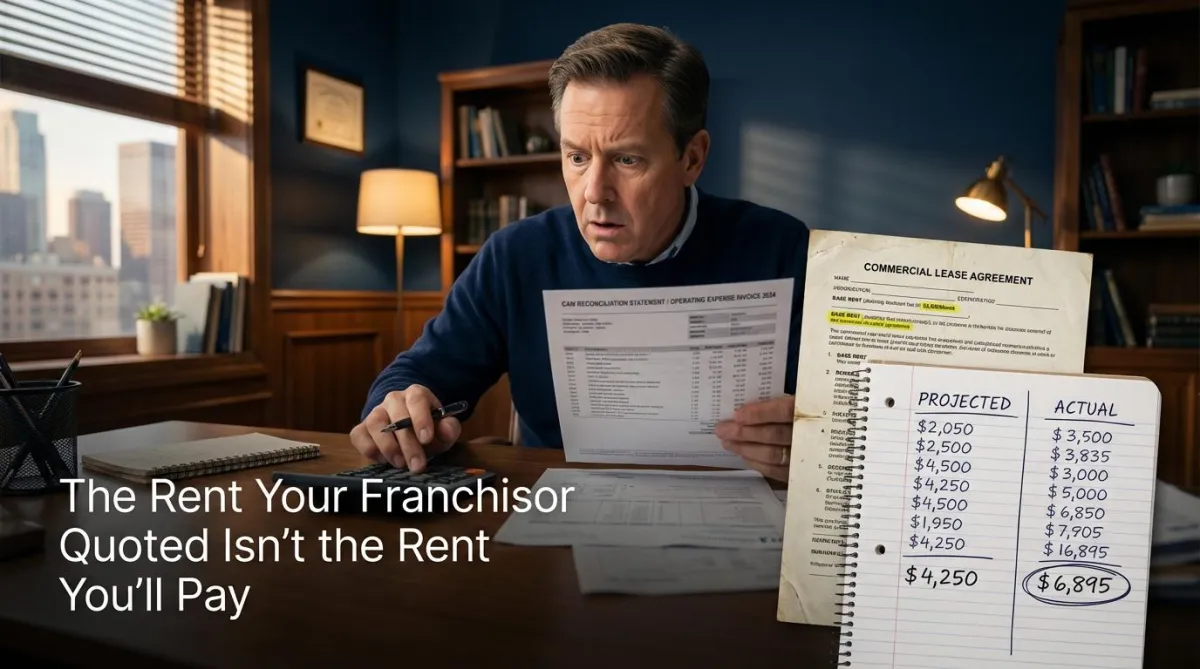
A fitness franchisee budgeted $4,200 per month for rent on a new location. That was the base rent quoted during site approval. By the time she added her CAM charges, property taxes, insurance allocations, and the landlord’s management fee, her actual monthly occupancy cost was $5,900.
She hadn’t modeled operating expenses in her unit economics. The franchisor’s projections used base rent as the rent figure. And the CAM charges weren’t capped — meaning they could increase every year without limit.
CAM charges — Common Area Maintenance charges — are a standard feature of retail and commercial center leases. For franchise tenants, they carry unique risks that independent tenants don’t face to the same degree. This post explains how CAM works in franchise leases, where the franchise-specific risks amplify the standard CAM problems, and what to negotiate before signing.
If you want to know exactly how CAM is structured in your franchise lease, run it through sasir.ai — our AI-powered lease analysis tool. The first scan is free.
CAM Basics: What You’re Paying For
CAM charges are the tenant’s proportionate share of the costs to maintain and operate the common areas of the property — parking lots, landscaping, lighting, signage, cleaning, security, and property management. In most retail and commercial center leases, these are passed through to tenants in addition to base rent.
The tenant’s share is typically calculated as their proportionate square footage relative to the total leasable area of the property. If you occupy 2,000 square feet in a 20,000 square foot center, your CAM share is 10 percent of the total CAM expenses for the center.
In a well-negotiated lease, CAM charges are:
Defined precisely — specific list of included expenses, specific exclusions
Capped — controllable CAM cannot increase more than a defined percentage per year
Auditable — tenant has the right to review landlord’s records annually
Reconciled annually — estimated charges are trued up against actual costs
In a landlord-drafted franchise lease that hasn’t been adequately negotiated, CAM charges may be broadly defined, uncapped, and calculated on a basis that includes expenses that shouldn’t be passed to tenants at all.
The Franchise-Specific CAM Problems
While CAM issues affect all commercial tenants, franchise tenants face several additional layers of risk:
Problem 1: The franchisor’s projections use base rent, not total occupancy cost. Franchise disclosure documents (FDDs) and franchisor-provided financial projections often model unit economics using base rent as the lease cost figure. CAM, taxes, insurance, and management fees are frequently either excluded from the model or estimated conservatively. Franchisees building their business case on franchisor-provided projections may be significantly underestimating their actual occupancy cost.
Problem 2: Franchisees in multi-tenant franchise centers share CAM exposure with co-tenants who may not be reliable. In a center where multiple tenants are franchisees of various systems, the financial strength of those co-tenants affects the overall health of the center — and therefore the landlord’s ability to maintain CAM expenses at reasonable levels. Vacant spaces in the center can shift more of the CAM burden to remaining tenants if the lease uses a denominator that reflects total leasable area rather than occupied area.
Problem 3: Franchise buildouts often create higher proportionate restoration and maintenance obligations. A franchise-standard buildout with specific fixtures, finishes, and equipment creates restoration obligations at lease expiration that can be classified as CAM-related expenses for the common benefit if the lease definition is broad enough. Vague CAM language that allows the landlord to pass through costs ‘incidental to the operation and maintenance of the property’ can sweep in franchise-buildout-related costs.
Problem 4: The franchisor may impose additional requirements that add to CAM-like costs. Some franchise agreements require the franchisee to contribute to center-wide marketing or promotional programs, maintain specific exterior appearances, or participate in common area events — all of which can add costs that function like CAM but aren’t disclosed in the lease’s CAM section.
The bottom line on franchise CAM risk: franchisees often sign leases in retail centers without fully modeling their total occupancy cost — because the franchisor’s projections focused on base rent. CAM charges can add 25 to 50 percent or more to the base rent figure in an uncapped NNN or modified gross lease.
What the CAM Definition Actually Controls
The CAM definition is the most important provision in the operating expense section of any retail lease. It determines what the landlord can bill to tenants — and in many landlord-drafted leases, it is intentionally broad.
Red flag language in CAM definitions:
‘Including but not limited to’ — this phrase allows the landlord to add new cost categories beyond those listed
‘As reasonably determined by Landlord’ — landlord-discretion language with no objective standard
‘Capital improvements necessary to maintain the property’ — capital expenses should be excluded from CAM entirely; they’re building upgrades, not maintenance
‘Management fees’ without a stated cap — management fees above 5 percent are markup, not overhead
‘All costs and expenses incurred in connection with the operation of the property’ — a catch-all that can include virtually anything
Green flag language in CAM definitions:
Specific itemized list of included expenses with no expanding catch-all
Explicit exclusion of capital improvements, depreciation, financing costs, and landlord’s overhead not directly related to center operations
Management fee capped at 3 to 5 percent of gross rents collected
Annual cap on controllable CAM increases (commonly 3 to 5 percent per year)
Gross-up provisions that prevent remaining tenants from bearing increased costs when vacancies rise
The Vacancy Problem: Gross-Up and Denominator Risk
One of the most underappreciated CAM risks in retail franchise leases is denominator risk — what happens to your CAM share when the center has vacant space.
If the lease uses total leasable square footage as the denominator for calculating your CAM share, your share stays constant regardless of vacancy. But if the landlord’s CAM costs are calculated on occupied space only — meaning fixed expenses like parking lot maintenance and lighting are allocated among a smaller pool of paying tenants when vacancies rise — your per-square-foot CAM cost increases as other tenants leave.
The solution: a gross-up provision. ‘CAM expenses shall be calculated as if the property were at least 95 percent occupied.’ This caps the denominator risk by ensuring that fixed CAM expenses are always allocated across a full occupancy baseline rather than only among occupied tenants.
The Audit Right: Your Protection Against CAM Overcharges
Almost every well-negotiated commercial lease gives the tenant the right to audit the landlord’s CAM records. In franchise leases that haven’t been carefully reviewed, this right is frequently either absent or structured in ways that make it practically unusable.
What a real audit right looks like:
Right to audit exercisable once per year within 12 months of receiving the annual CAM reconciliation statement
Landlord must provide supporting documentation within 30 days of audit request
If audit reveals an overcharge of more than 3 to 5 percent, landlord pays the cost of the audit
Audit findings are binding on both parties unless disputed within a defined window
Request historical CAM reconciliation statements before signing. If the landlord cannot provide three years of actuals, that is a data point about their record-keeping and their willingness to be transparent about operating costs.
What to Negotiate
Define CAM expenses specifically by itemized list, not by catch-all language
Exclude capital improvements, depreciation, financing costs, and non-operational landlord overhead
Cap controllable CAM increases at 3 to 5 percent per year
Cap management fee at 3 to 5 percent of gross rents
Include a gross-up provision protecting against denominator risk from vacancies
Secure an annual audit right with landlord cost-bearing if overcharge exceeds defined threshold
Request three years of historical CAM actuals before signing
Model total occupancy cost — base rent plus CAM, taxes, insurance, and management — before finalizing unit economics
The Bottom Line
Franchise unit economics are frequently modeled on base rent. Actual occupancy cost includes CAM, taxes, insurance, and management fees that can add 25 to 50 percent or more to the base rent figure in an uncapped lease.
The CAM definition, the controllable CAM cap, the gross-up provision, and the audit right are the four provisions that determine whether your operating expenses are predictable and bounded — or open-ended and outside your control. Negotiate all four before you sign.
Related resources for franchise tenants and general CAM readers:
CAM Charges Explained: What They Are, What’s Hiding Inside, and How Most Tenants Overpay
Triple Net Lease Explained: What NNN Really Costs and What Most Tenants Get Wrong
The Franchise Lease Trap: Why Franchisees Face Lease Risks That Independent Tenants Don’t
If you want to know exactly how CAM is structured in your franchise lease, run it through sasir.ai. The first scan is free.