The Co-Tenancy Clause in a Commercial Lease: What Happens When the Anchor Leaves and Why Most Tenants Have No Protection
A gift shop owner signed a five-year lease in a regional mall anchored by a major department store. Her location was chosen specifically because of the foot traffic the anchor generated — thousands of daily visitors who walked past her storefront en route to the department store.
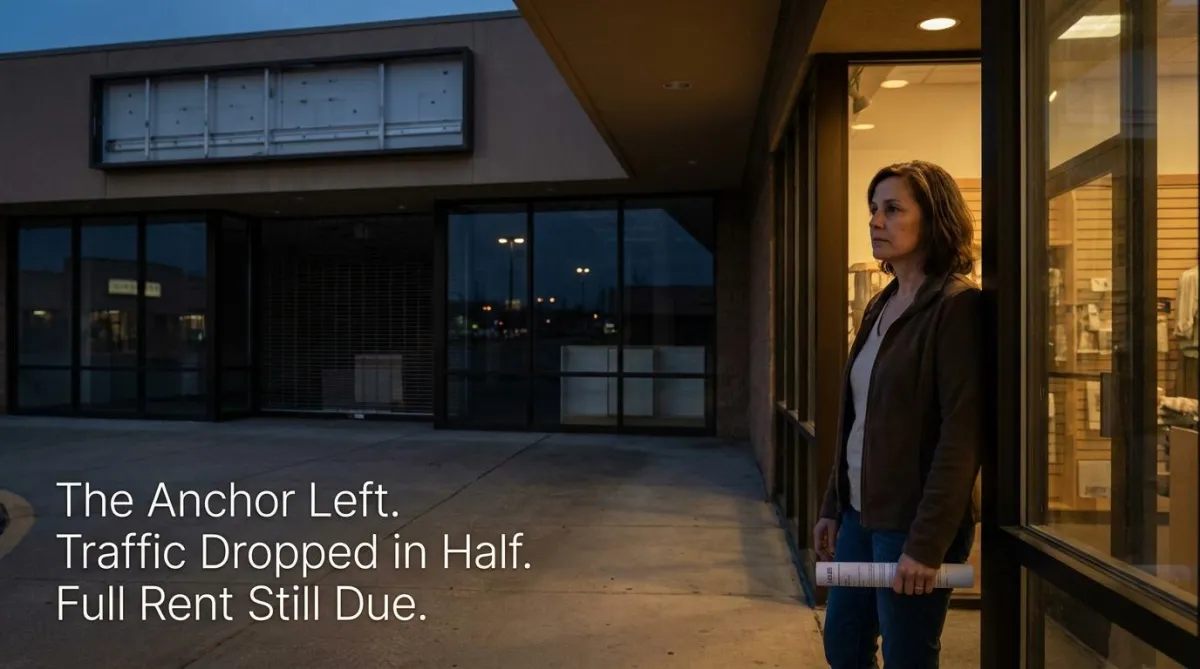
Sixteen months after opening, the department store announced it was closing that location. Within sixty days the anchor was dark. Center traffic dropped by more than half. The gift shop’s revenue fell 40 percent. She had three and a half years left on her lease. Her rent obligation didn’t change.
There was no co-tenancy clause. She had no right to a rent reduction. She had no exit right. She paid full rent on a space that was now commercially viable only as a memory of the location she had originally signed for.
The co-tenancy clause is the lease provision that addresses exactly this scenario: the risk that the tenant mix around you — specifically the anchor tenant whose traffic justified your site selection — changes materially during your lease term. For any retail, restaurant, fitness, or service business whose customer flow depends on the presence of a high-traffic neighbor, the co-tenancy clause is one of the most important protections in the lease. Most landlord-drafted leases don’t include it.
If you want to know whether your commercial lease has a co-tenancy clause and how it’s structured, run it through sasir.ai — our AI-powered lease analysis tool. The first scan is free.
What a Co-Tenancy Clause Is
A co-tenancy clause is a lease provision that defines the tenant mix conditions the tenant’s location depends on — and provides specific remedies if those conditions change materially during the lease term.
The clause typically works in two ways:
Opening co-tenancy: the tenant’s obligation to take occupancy and begin paying rent is conditioned on one or more named tenants (or a defined occupancy threshold) being open and operating at the time of lease commencement. If the anchor isn’t open when the tenant opens, the tenant has rights to delay rent commencement or terminate the lease before it starts.
Ongoing co-tenancy: the tenant’s rent obligation is modified if the anchor goes dark or the center’s overall occupancy falls below a defined threshold during the lease term. This is the protection that matters most for an operating business — because opening co-tenancy only protects against a problem visible at signing, while ongoing co-tenancy protects against what happens after the tenant has invested in the buildout and built their customer base.
The opening co-tenancy addresses risk you can see at signing. The ongoing co-tenancy addresses risk that materializes after you’ve committed. For most operating businesses, the ongoing clause is the critical one.
Why Most Commercial Tenants Need It and Most Landlords Won’t Offer It
Landlords resist co-tenancy clauses because they cap the landlord’s rental income and create termination risk in the event of anchor departure. From the landlord’s perspective, a co-tenancy clause is a concession that reduces their leverage when the center’s occupancy weakens — exactly when they need cash flow stability most.
Tenants need co-tenancy protection because the site selection decision that drove them to a specific location was, at least in part, based on the existing tenant mix. A gift shop that signed in a mall because of department store traffic, a restaurant that signed in a center because of a grocery anchor, a fitness studio that signed near a cinema complex — these businesses made location decisions that depended on co-tenant traffic. When the co-tenant leaves, the location may no longer support the economics that justified signing the lease.
The power to negotiate a co-tenancy clause is highest at lease signing, when the landlord needs a tenant to fill the space. It is lowest after an anchor departure, when the landlord is managing center instability and has no incentive to provide additional concessions to existing tenants.
How a Well-Structured Co-Tenancy Clause Works
A well-negotiated ongoing co-tenancy clause has four components:
1. The trigger. The anchor goes dark — meaning ceases to operate in the center — for more than a defined period. Thirty to ninety days is the typical trigger threshold. The trigger should be based on the anchor ceasing operations, not on their lease expiring. An anchor whose lease ends but who continues to operate is not a co-tenancy failure; an anchor who closes but whose lease continues is.
2. The rent remedy. Once the trigger is met, rent converts automatically to a percentage of gross sales for the duration of the co-tenancy failure. The percentage is typically 4 to 8 percent of gross sales, depending on the lease type and the tenant’s margin profile. This converts the tenant’s fixed rent obligation into a variable one that tracks actual revenue — so the tenant isn’t paying full rent on declining revenue caused by a condition outside their control.
3. The exit right. If the co-tenancy failure continues beyond a defined period — typically twelve months from the initial trigger — the tenant has the right to terminate the lease with defined notice (usually 60 to 90 days). This exit right is what converts the clause from a rent reduction tool into a genuine business protection: if the anchor has been dark for a year with no replacement, the tenant can leave rather than serving out the remainder of their lease term at reduced revenue.
4. The replacement standard. Define what constitutes adequate replacement of the departed anchor. A department store whose traffic generated 3,000 daily center visits is not replaced by a dollar store. The replacement standard should specify the type of tenant (by category), minimum size, and in some cases minimum traffic generation, required to cure the co-tenancy failure.
A co-tenancy clause with only a rent remedy and no exit right gives the tenant a financial cushion but no escape route. If the anchor has been dark for two years with no replacement, the rent reduction may not be sufficient to sustain the business. The exit right is the provision that gives the clause its full protective value.
What to Negotiate
Name the anchor explicitly: ‘If [Department Store] ceases to operate at [address]’ is stronger than ‘if center occupancy falls below 75%.’ Generic occupancy thresholds can be met by tenants who don’t generate meaningful traffic, masking the practical impact of the anchor’s departure.
Set a reasonable trigger threshold: 30 to 90 days of continuous non-operation is standard. Shorter is better for the tenant. A 90-day threshold means the tenant pays full rent for three months after the anchor closes before any remedy applies.
Define the percentage rent remedy: 4 to 8 percent of gross sales, payable monthly with a true-up. Include a reconciliation process and an audit right.
Negotiate the exit right: 12 months from the initial trigger is the standard window. Include a requirement that the anchor not be replaced by a qualified replacement during that period.
Define replacement adequacy: by category, minimum square footage, and opening date. The cure should be actual operation, not just a signed lease with a future opening.
Make the remedy automatic: the rent reduction should take effect automatically upon the trigger, not require the tenant to give notice, negotiate, or litigate to access the protection.
The Occupancy Threshold Alternative
For tenants in multi-tenant centers without a single dominant anchor, an occupancy-based co-tenancy clause may be more appropriate than a named-anchor clause. The structure: if the center’s occupancy (measured by square footage leased to open and operating tenants) falls below a defined threshold — commonly 70 to 80 percent — the tenant’s rent converts to percentage of sales with an exit right if the low occupancy persists.
The risk with occupancy-based clauses: the landlord may maintain technical occupancy levels by signing short-term leases with low-traffic tenants who occupy square footage without generating meaningful customer flow. For businesses whose revenue depends on specific customer profiles, a named-anchor clause is more protective.
The Bottom Line
An anchor tenant departure can halve a retail center’s foot traffic. A commercial tenant with no co-tenancy clause pays full rent throughout the decline, for the full remaining term, with no remedy and no exit. A co-tenancy clause doesn’t prevent the anchor from leaving. It protects the tenant’s economics if it does.
Negotiate the trigger, the rent remedy, the exit right, and the replacement standard before signing. These provisions are hardest to negotiate after the anchor has already announced its departure.
Related resources:
If you want to know whether your commercial lease has a co-tenancy clause, run it through sasir.ai. The first scan is free.