When Your Franchisor’s Requirements Conflict With Your Lease: How to Spot the Gaps Before They Cost You
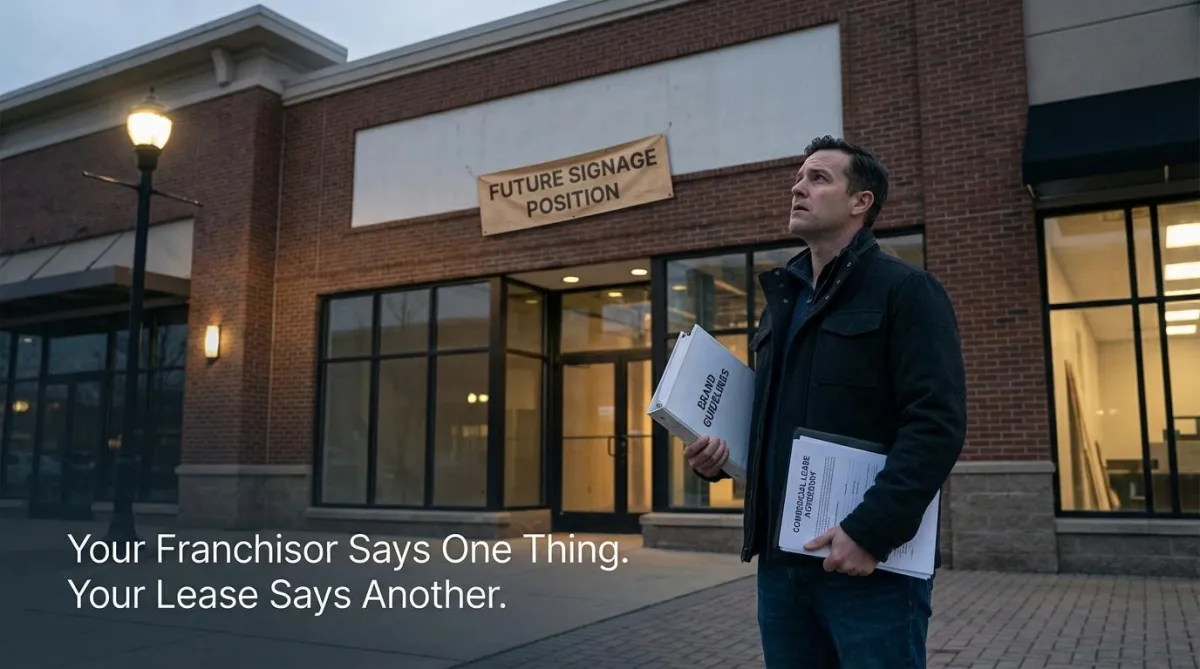
A fast casual franchisee signed a lease and began buildout. The franchisor’s brand standards required specific exterior signage — a backlit channel letter sign in exact dimensions and color. The lease required landlord approval for all exterior signage and prohibited backlit signs.
The franchisor wouldn’t waive the signage requirement. The landlord wouldn’t approve the sign. The franchisee was caught between two binding obligations with no clean way out. After months of negotiation, the sign was modified — out of brand standard compliance — and the franchisor issued a notice of non-compliance.
This is a different problem from the franchise lease traps we covered previously. Those were structural issues: term misalignment, assignment blocks, guarantee gaps. This is an operational conflict: the franchisor’s day-to-day requirements running directly into what the lease permits or prohibits.
For franchisees, this conflict is avoidable — but only if you identify the friction points before you sign both documents. This post explains where franchisor requirements most commonly clash with lease terms, and how to resolve each before they put you in breach of one or both agreements.
If you want to know how your franchise lease handles these operational provisions, run it through sasir.ai — our AI-powered lease analysis tool. The first scan is free.
Why This Conflict Is Structural
The franchise agreement is written by the franchisor’s legal team to protect the brand, ensure system consistency, and maintain operational standards. It dictates signage, hours, layout, buildout specifications, approved vendors, marketing requirements, and renovation timelines.
The commercial lease is written by the landlord’s legal team to protect the property, manage tenant behavior, and control what happens inside the building. It restricts modifications, requires approval for signage, limits operating hours, controls who performs work on the space, and defines restoration obligations.
Neither document was written with the other in mind. The franchisor doesn’t know your landlord’s restrictions. The landlord doesn’t know your franchisor’s requirements. The franchisee is the only party bound by both — and the conflicts are rarely obvious until you’re already operating.
The diagnostic question before signing either document: can I comply fully with the franchise agreement while staying within the boundaries of the lease? If the answer is uncertain, you haven’t finished the review.
Conflict 1: Signage
Franchise systems are built on visual brand consistency. The franchisor’s operations manual typically specifies sign dimensions, materials, lighting type (backlit, halo-lit, or non-illuminated), placement, and approved color codes down to the Pantone number.
Commercial leases frequently restrict signage in ways that directly collide with these specifications:
Requiring landlord approval for all exterior signage — approval that may be withheld or conditioned on modifications
Prohibiting illuminated or backlit signs entirely
Restricting sign placement to designated areas that may not match the franchisor’s required position
Limiting sign dimensions to maximums smaller than the franchisor’s standard
Requiring removal of all signage at lease expiration and restoration to original condition — at tenant cost
Resolution approach: before signing the lease, obtain the franchisor’s exact signage specifications in writing and compare them against the lease’s signage provisions. Negotiate a specific carve-out: ‘Landlord hereby pre-approves exterior signage consistent with Tenant’s Franchise Agreement requirements, as provided to Landlord in writing prior to lease execution.’ Get this in writing, in the lease, before signing.
Conflict 2: Operating Hours
Franchisors mandate operating hours as a system requirement. A national quick service restaurant brand may require 6 AM to 11 PM hours seven days a week. A fitness franchise may require 5 AM opening to accommodate the before-work class schedule that drives membership revenue.
Leases restrict operating hours in several ways:
Requiring ‘continuous operation’ during defined center hours — which may be shorter than the franchisor requires
Prohibiting early morning or late evening operation due to shared building access, HVAC scheduling, or parking structure restrictions
Requiring landlord approval to operate outside defined center hours
Prohibiting 24-hour operation where the franchise system requires it
Resolution approach: obtain the franchisor’s required operating hours and compare them against the lease’s hours restrictions and continuous operation clause. Negotiate explicit permission in the lease for the hours the franchise system requires. If the building has operational constraints (HVAC, parking, building access), negotiate who bears the cost of extended access and confirm that those costs don’t undermine the unit economics.
A franchisee who cannot open at 5 AM because the building HVAC doesn’t start until 6 is both out of brand compliance and losing the peak revenue hour that drove the site selection decision.
Conflict 3: Buildout Specifications and Approved Vendors
Franchise agreements typically require buildout to be completed according to the franchisor’s design standards, using approved contractors, approved materials, and in some systems, franchisor-approved vendors for specific equipment categories. The franchisor may also require periodic renovations or rebrands on a defined schedule.
Leases create friction here in several ways:
Requiring landlord approval for all alterations, with review periods that may conflict with the franchisor’s buildout timeline
Restricting the contractors who can perform work in the building — which may exclude the franchisor’s required vendors
Requiring restoration of the space to original condition at lease expiration — which can make expensive franchise-mandated buildout elements unrecoverable investments
Limiting the scope of permitted alterations in ways that conflict with mandatory rebrand specifications
Resolution approach: share the franchisor’s buildout specifications and renovation schedule with the landlord before signing. Negotiate: (1) a streamlined approval process for alterations required by the franchise system; (2) explicit permission for the franchisor’s required vendors and contractors; and (3) a negotiated restoration standard that exempts franchise-standard improvements from removal requirements.
Conflict 4: Renovation and Rebrand Obligations
Most franchise systems require franchisees to renovate or rebrand their locations on a defined cycle — often every five to seven years — to maintain system consistency. This is not optional: failure to complete a required rebrand can constitute a material breach of the franchise agreement.
The lease creates two obstacles:
First: the lease may require landlord approval for renovations, with no defined timeline for that approval and no consequence for delay. A landlord who takes six months to approve a renovation the franchisor requires within ninety days creates a compliance problem that the franchisee cannot resolve without risking a franchise agreement breach.
Second: the lease may require that the space be returned to its original condition at expiration, which means the franchisee’s rebrand investment — potentially $200,000 or more in a comprehensive renovation — has to be demolished at the end of the lease.
Resolution approach: negotiate a fast-track approval process for system-required renovations (landlord must respond within 15 to 30 days, approval deemed granted if no response). And negotiate a restoration standard that treats franchise-required improvements as permanent improvements to the landlord’s property, not tenant alterations subject to removal.
Conflict 5: Exclusive Territory vs. Lease Exclusivity
Many franchise agreements grant the franchisee an exclusive territory — a defined geographic area within which the franchisor will not authorize a competing franchisee. This is a franchise agreement right, not a lease right. The landlord is not party to the franchise agreement and has no obligation to honor the exclusive territory.
The result: the franchisor’s territorial protection doesn’t extend to what the landlord does with the rest of the building or center. If the landlord leases adjacent space to a competing concept — even one from the same franchise system — the franchisee’s only protection is a lease exclusivity clause that they negotiated separately.
Many franchisees assume the territorial protection in their franchise agreement covers them within the shopping center. It doesn’t. Negotiate an explicit exclusivity clause in the lease that mirrors and extends the franchise territory protection within the property.
The Resolution Protocol: Two Documents, One Review
The only reliable way to identify franchisor-lease conflicts before signing is to review both documents simultaneously against a checklist:
Signage: franchisor specs vs. lease signage restrictions — match or conflict?
Hours: franchisor required hours vs. lease permitted hours and continuous operation clause
Buildout: franchisor required contractors and materials vs. lease alteration approval and vendor restrictions
Renovation cycle: franchisor rebrand schedule vs. lease approval timeline and restoration obligation
Territory: franchise territory boundaries vs. lease exclusivity clause
Use clause: full franchise system scope vs. permitted use definition
Any item on this list where the answer is ‘conflict’ or ‘unclear’ needs to be resolved in the lease before you sign it. Once both documents are fully executed, you own the conflict.
The Bottom Line
Your franchisor will hold you to their standards. Your landlord will hold you to the lease. When those two sets of requirements conflict, you’re in breach of one or both — and neither party takes responsibility for the other’s document.
Review both contracts together. Resolve every conflict before signing. The time to do this is during lease negotiation, not after opening.
Related resources for franchise tenants:
The Franchise Lease Trap: Why Franchisees Face Lease Risks That Independent Tenants Don’t
The Use Clause in a Commercial Lease: Why a Narrow Permitted Use Can Cap Your Business
Tenant Improvement Allowance: What It Is, What’s Hidden, and How to Negotiate It
If you want to know how your franchise lease handles these operational provisions, run it through sasir.ai. The first scan is free.