Indemnification in Commercial Leases: How a Standard Clause Can Shift Massive Liability to Tenants
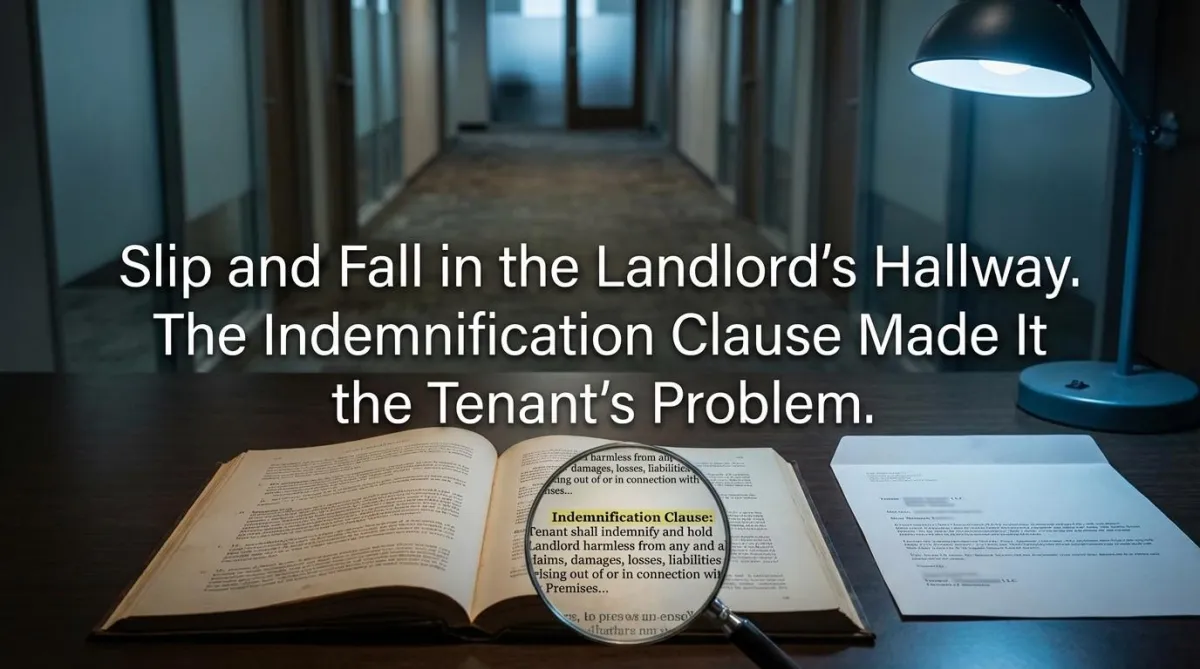
A retail tenant’s customer slipped and fell in the building’s common area — a hallway maintained by the landlord. The customer sued both the tenant and the landlord. Under the lease’s indemnification clause, the tenant had agreed to indemnify and hold the landlord harmless from ‘any and all claims arising out of or in connection with the premises or the tenant’s use thereof.’
The landlord tendered the defense of the claim to the tenant’s insurer and demanded the tenant cover their legal fees. A slip and fall in the landlord’s hallway — in a space the landlord maintained — became the tenant’s financial problem because of a broadly drafted indemnification clause that wasn’t limited to the tenant’s own negligence.
Indemnification clauses in commercial leases are designed to allocate risk between the landlord and tenant. A well-drafted clause allocates risk to the party whose conduct created it. A landlord-friendly clause shifts virtually all risk to the tenant — including risk from events caused by the landlord’s own negligence or failures.
If you want to know how your lease’s indemnification clause is structured, run it through sasir.ai — the first scan is free.
What a Landlord-Drafted Indemnification Clause Looks Like
A broad landlord-drafted indemnification provision typically requires the tenant to indemnify and hold harmless the landlord from:
Any and all claims, losses, damages, costs, and expenses
Arising out of or in connection with the tenant’s use or occupancy of the premises
Or arising out of or in connection with the premises
The phrase ‘arising out of or in connection with the premises’ — as opposed to ‘caused by the tenant’s negligence’ — is the critical distinction. Broad connection language can sweep in claims that have nothing to do with the tenant’s conduct: a landlord maintenance failure, a building system defect, an injury in the common area. If the premises connection is enough to trigger indemnity, the tenant is potentially responsible for harms they didn’t cause.
The standard for a fair indemnification clause is fault-based allocation: each party indemnifies the other for losses caused by that party’s own negligence or willful misconduct. A tenant who signs a one-sided indemnification clause may be paying for the landlord’s mistakes.
What a Well-Negotiated Indemnification Clause Looks Like
Mutual indemnification: both parties indemnify the other for losses caused by their own negligence or willful misconduct. Neither party indemnifies the other for the other party’s negligence.
Negligence-based standard: the trigger for indemnity is the indemnifying party’s own negligence or willful misconduct — not the broader ‘arising out of’ connection to the premises or use.
Carve-out for landlord negligence: explicitly exclude from the tenant’s indemnity obligation any claims caused in whole or in part by the landlord’s negligence, gross negligence, or willful misconduct.
Proportionate allocation for shared negligence: if both parties contributed to a loss, each indemnifies proportionately to their share of fault rather than one party bearing the entire obligation.
The Bottom Line
A one-sided indemnification clause doesn’t just shift paperwork. It shifts real financial liability — defense costs, settlement amounts, and judgment payments — to a tenant for events they didn’t cause and can’t control. Negotiate a fault-based, mutual indemnification standard before signing.
Related articles:
Run your lease through sasir.ai. First scan is free.