Parking Rights in Commercial Leases: What ‘Access to Parking’ Actually Means and Why Vague Language Can Strand Your Customers
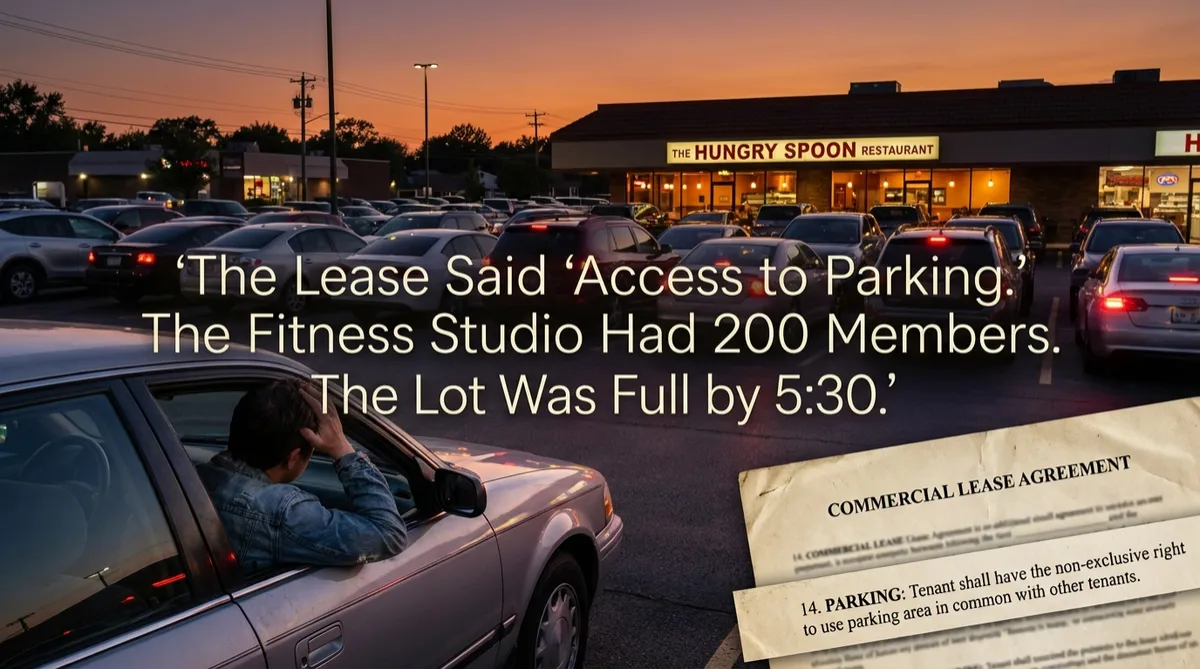
A fast casual restaurant signed a lease in a mixed-use center. The lease granted the tenant ‘the right to use the parking area in common with other tenants.’ Two years in, the landlord leased the adjacent space to a fitness studio with evening classes. By 5:30 PM every weekday, the shared parking was at capacity with studio members. Restaurant dinner customers couldn’t park. Revenue dropped on weekday evenings.
The restaurant had parking rights. ‘In common with other tenants’ meant exactly that — equal access with unlimited competing demand. The lease didn’t specify a minimum number of spaces, didn’t restrict competing uses that would saturate the parking, and didn’t provide any remedy for shared-parking overflow.
Parking rights in commercial leases are frequently vague, frequently inadequate, and frequently discovered to be insufficient only after a business has been operating long enough to understand its customer parking pattern.
If you want to know how your lease defines your parking rights, run it through sasir.ai — the first scan is free.
What ‘Access to Parking’ Can Mean
Commercial lease parking provisions range from specific to nearly meaningless:
Dedicated spaces: a defined number of spaces exclusively assigned to the tenant, marked and unavailable to other tenants or customers. The strongest protection.
Reserved spaces with right to use common parking: a defined number of the tenant’s spaces are reserved, plus unlimited access to the common parking area. Offers some guarantee while preserving shared access.
Right to use parking in common with other tenants: no dedicated spaces, equal access to a shared lot with all other tenants and their customers. No guarantee of availability.
Parking based on square footage ratio: the tenant has access to a defined number of spaces calculated as a ratio of their square footage to total center square footage. May still leave the tenant with fewer spaces than their operation requires.
What to Negotiate
Minimum guaranteed spaces: negotiate a defined number of spaces that the landlord must ensure are available to the tenant and the tenant’s customers during business hours, regardless of shared demand.
Location of reserved spaces: specify that dedicated spaces are within a defined distance of the premises entrance — not in a remote portion of the parking area.
Landlord obligation to manage competing demand: if the parking is shared, negotiate a landlord obligation to actively manage overflow situations, including restricting other tenants from using disproportionate parking during defined peak hours.
Remedy for parking failure: if the landlord fails to maintain the minimum guaranteed spaces for a defined period, the tenant has specific remedies — rent reduction, termination right, or right to lease alternative parking at landlord’s cost.
Protection against parking area reduction: the landlord should not be able to reduce the size of the parking area or convert parking spaces to other uses without the tenant’s consent during the lease term.
The Bottom Line
Parking rights are not a secondary lease issue for businesses that depend on customer access by car. Vague ‘access to parking’ language is not protection. Negotiate guaranteed spaces, location requirements, and a remedy for parking failure before signing — especially if the center has or may have high-traffic co-tenants who share the parking area.
Related articles:
Run your lease through sasir.ai. First scan is free.