Co-Tenancy Clauses in Franchise Leases: Why the Tenant Mix Around You Determines Whether Your Location Works
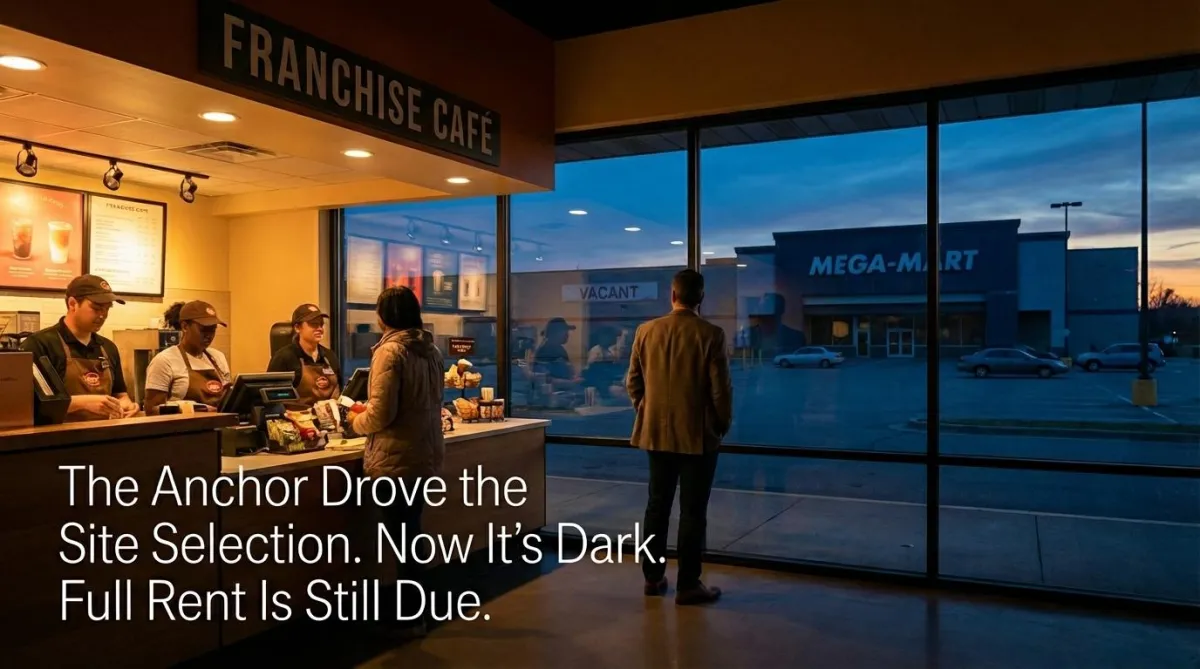
A quick service restaurant franchisee signed a lease in a shopping center anchored by a national grocery chain. The franchisor approved the site. The grocery anchor drove 3,000 daily visits. The franchise unit economics were built on that traffic.
Fourteen months after opening, the grocery chain announced store closures. Their location in this center closed within sixty days. Within six months, three other tenants in the center had followed. The franchisee’s customer count dropped 35 percent. Revenue fell below the level needed to service the lease.
There was no co-tenancy clause in the lease. Full rent was due regardless of the anchor’s status. The franchisee had no exit right. The location continued for two more years at a loss before the lease could be restructured.
Co-tenancy protection is the lease provision that directly addresses anchor dependency risk — the risk that the tenant mix around you, which was a core assumption of the site selection, changes materially during your lease term. For franchise tenants in retail and commercial centers, it is one of the most important protections that most landlord-drafted leases don’t include.
If you want to know whether your franchise lease has co-tenancy protection, run it through sasir.ai — the first scan is free.
What Co-Tenancy Is and Why It Matters for Franchisees
A co-tenancy clause is a lease provision that defines the tenant mix conditions the franchisee’s location depends on — and provides remedies if those conditions change. There are two main types:
Opening co-tenancy: the franchisee’s obligation to take occupancy and begin paying rent is conditioned on one or more named tenants (or a defined occupancy level) being open and operating at the time of lease commencement. If the anchor isn’t open when the franchisee opens, the franchisee has rights to delay rent commencement or exit.
Ongoing co-tenancy: the franchisee’s rent obligation is modified if the anchor tenant goes dark or the center’s occupancy falls below a defined threshold during the lease term. Typical structure: if the anchor is dark for more than 90 days, rent reduces to 4–7% of gross sales until the anchor reopens or is replaced. If the anchor is dark for more than 12 months, the franchisee has the right to terminate.
For franchise tenants, the ongoing co-tenancy clause is typically the more critical provision. The opening co-tenancy addresses a risk that’s visible at signing. The ongoing co-tenancy addresses the risk that materializes after the franchisee has invested in the buildout, established their customer base, and committed to the location for the full lease term.
The site approval decision was based on the tenant mix as it existed when the franchisor evaluated the site. The co-tenancy clause is the only contractual protection against the tenant mix changing materially after the franchisee has committed.
Why Franchise Tenants Face Higher Co-Tenancy Risk
Franchise sites are frequently selected based on traffic driven by co-tenants. The grocery anchor, the fitness anchor, the entertainment destination, or the retail cluster that generates the foot traffic the franchise unit economics depend on was a feature of the site selection analysis.
Unlike independent tenants who may have more flexibility to pivot their concept or customer base, franchise operators must maintain brand standards that tie them to a specific customer profile. If the customer traffic that the brand’s operating model depends on disappears because the anchor went dark, the franchisee cannot easily pivot their business to attract a different customer.
Additionally, the franchisor’s site approval was based on the center’s existing tenant mix. When that mix changes, the location that the franchisor approved may no longer be the location the franchisee is operating in. But the lease — and the personal guarantee — remain unchanged.
What to Negotiate
Named anchor protection: identify the one or two tenants whose presence materially drives traffic to your location. Negotiate their specific names into the co-tenancy clause. Generic occupancy thresholds (‘if center occupancy falls below 75%’) are less protective than named-anchor provisions (‘if [Grocery Chain] ceases to operate at [Address]’).
Ongoing rent reduction: if the named anchor goes dark, rent reduces to a percentage of gross sales (4–7% is standard) within 30 to 60 days of the dark trigger, not after a lengthy dispute resolution process. The reduction should be automatic, not subject to landlord consent.
Exit right: if the anchor is dark for more than 12 months without a replacement tenant meeting defined criteria (e.g., an anchor-category tenant of similar traffic generation), the franchisee has the right to terminate with defined notice (typically 90 days).
Replacement standard: define what qualifies as an adequate anchor replacement. A national grocery chain is not replaced by a discount clothing store. Specify the replacement criteria by category, square footage, and minimum traffic-generation profile.
The Bottom Line
Co-tenancy protection converts anchor dependency from an unmitigated business risk into a manageable lease provision. The negotiation is straightforward at signing. After the anchor goes dark — when you need the protection most — the landlord has no incentive to give it to you.
Related articles:
Run your franchise lease through sasir.ai. First scan is free.