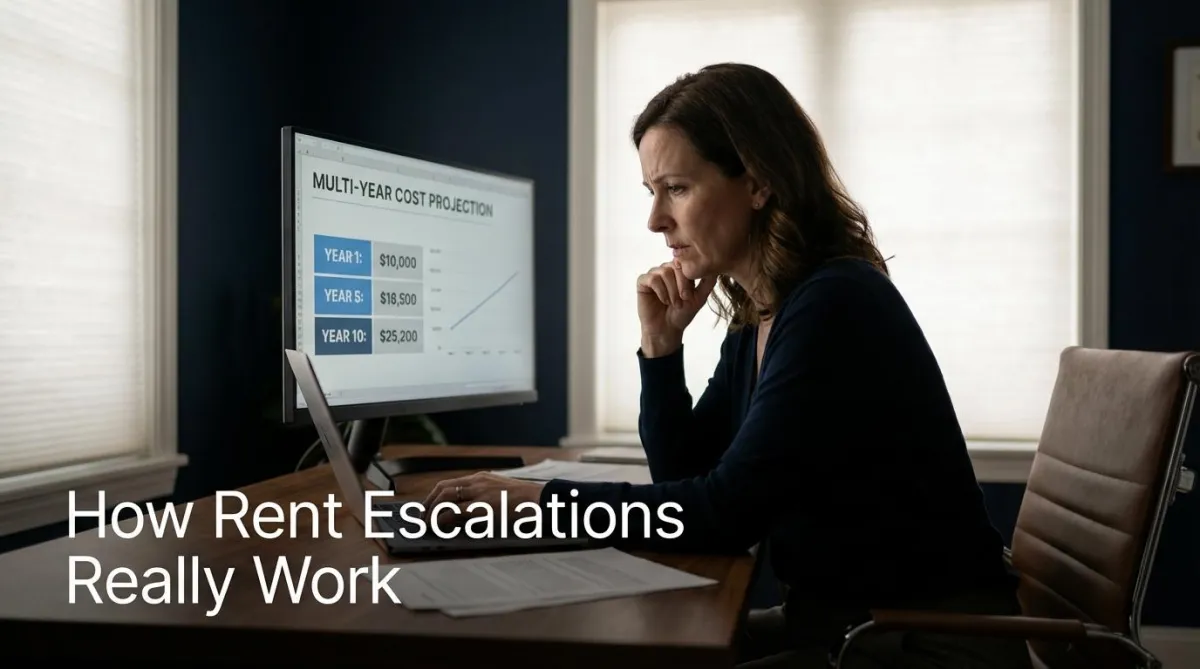
How Rent Escalations Work in Commercial Leases — and Why Small Annual Increases Become Big Long-Term Costs
Year one: $5,000 a month. Year five: $6,083. Year ten: $7,401.
That’s the math on a 5-year lease with a standard 3% annual escalation. No surprises in year one. A meaningful gap by year five. And if you renewed into a second term at the same structure, your rent is nearly 50% higher than when you started.
Rent escalations are one of the most common provisions in commercial leases and one of the most consistently underestimated by tenants. The percentage seems small. The compounding effect is not.
This post explains how escalation clauses work, the three structures you’ll encounter, which one creates the most risk, and what to negotiate before you sign.
If you want to see how your escalation clause compounds over your full lease term, run your lease through sasir.ai — our AI-powered lease analysis tool. The first scan is free.
What a Rent Escalation Clause Is
A rent escalation clause — also called an annual rent increase, step-up clause, or rent adjustment provision — is the mechanism in your lease that determines how and when your rent increases over the term.
In a flat lease, rent stays the same for the entire term. These are rare in commercial real estate. In most commercial leases, rent increases annually or at set intervals, and the escalation clause defines the formula.
There are three common structures, and they carry very different levels of risk.
The Three Escalation Structures
Fixed percentage increase. Your rent goes up by a defined percentage each year — commonly 2%, 3%, or 5%. The increase is predictable and calculable at signing. A $5,000/month lease with a 3% annual escalation will be $5,150 in year two, $5,305 in year three, and so on. You can model the full cost of the lease on a napkin before you sign.
This is the most tenant-friendly structure because it’s entirely knowable. The risk is that in a low-inflation environment, a fixed 3% still increases faster than your revenue growth if the business is flat.
CPI-linked increase. Your rent increases by the rate of the Consumer Price Index — the official measure of inflation. When inflation is low (1–2%), this can feel benign. When inflation spikes — as it did in 2021–2023 — CPI-linked leases produced rent jumps of 7, 8, or 9% in a single year.
CPI-linked clauses pass inflation risk entirely to the tenant. If the economy experiences a spike, your rent spikes with it — regardless of what your revenue is doing.
Market rent (or ‘fair market value’) reset. At defined intervals — often at lease renewal or at a specific mid-term date — your rent resets to prevailing market conditions. If undefined, the landlord effectively controls the number. If market rents have risen significantly, a market reset can produce a far larger jump than any fixed or CPI escalation.
The risk ranking: Fixed percentage is most predictable. CPI is variable but traceable. Market rent without a defined process is the most dangerous — it puts the landlord in control of a number that has no ceiling and no independent verification unless you negotiate one.
Why 3% Doesn’t Feel Like 3%
The compounding effect of annual rent escalations is the part most tenants don’t model before signing.
Here’s the real math on a $5,000/month lease at 3% annual escalation over 10 years:
Year 1: $5,000/month — $60,000/year
Year 3: $5,305/month — $63,654/year
Year 5: $5,628/month — $67,533/year
Year 7: $5,970/month — $71,641/year
Year 10: $6,540/month — $78,480/year
Total rent paid over 10 years: approximately $706,000. At flat rent that would have been $600,000. The escalation clause alone added over $100,000 to the cost of the lease.
At 5% annual escalation, the year-10 monthly rent is $8,144. Over the full decade, the difference versus flat rent exceeds $200,000.
Today’s rent is marketing. Year-5 and Year-10 rent is reality. Run the full compounding math before you sign — not after.
CPI Risk: What Happened to Tenants Who Didn’t Cap It
CPI-linked escalations seemed conservative through most of the 2010s when inflation ran below 2%. Tenants and their advisors treated them as essentially equivalent to a fixed 2% increase.
Then 2022 arrived. CPI hit 8.5%. Tenants with uncapped CPI escalation clauses received rent increase notices for 8 or 9% — in a single year — during a period when many businesses were simultaneously dealing with supply chain disruptions, labor cost increases, and slowing consumer demand.
The lesson: CPI-linked escalations without a cap pass macroeconomic risk entirely to the tenant. The solution is straightforward: cap CPI increases at a fixed ceiling, regardless of actual inflation. A common negotiated cap: ‘rent shall increase by the lesser of CPI or 3% per year.’ That single clause converts variable, unlimited CPI exposure into a predictable maximum.
What to Negotiate Before You Sign
If fixed percentage: negotiate the rate down — 3% is common, 2% or 2.5% is achievable in many markets with a longer term or strong tenant profile
If CPI-linked: cap the maximum annual increase (3–4% is the standard negotiated ceiling)
If market rent reset: define the determination process (independent appraisal, or average of two appraisals) and cap the maximum reset percentage
Negotiate a base year: the first year rent is the baseline — escalations begin in year two, not year one
Request cumulative caps: some leases allow landlords to catch up on missed escalations; negotiate to prevent this
Model year 5 and year 10 rent before signing: verify that the compounded number works against your projected revenue
The escalation rate is negotiable. Most landlords have a starting position. Most tenants accept it without realizing that even a half-percentage-point reduction compounds to meaningful savings over a multi-year term.
The Bottom Line
Small annual increases become large long-term costs. A 3% escalation on a 10-year lease adds more than $100,000 to a $5,000/month starting rent. A 5% escalation adds more than $200,000. An uncapped CPI clause in a high-inflation year can produce a single-year jump larger than the entire escalation of the prior 5 years combined.
Know your structure. Model your full-term cost. Cap the variable clauses. And negotiate from that knowledge before the ink is dry.
If you’re navigating a commercial lease, these additional resources may help:
CAM Charges Explained: What They Are, What’s Hiding Inside, and How Most Tenants Overpay
Triple Net Lease Explained: What NNN Really Costs and What Most Tenants Get Wrong
If you want to see how your escalation clause compounds across your full lease term, run your lease through sasir.ai. The first scan is free.